How to determine the appropriate dock for your needs....
Roll-In or Wheel-In Docks
The roll-in was designed to
permit quick installation and removal of dock systems on
Minnesota’s and Wisconsin’s vast glacial lakes. Many of the
glacial lakes have gently sloping shorelines. We have found 32
feet to be an extremely common length when all sizes are
averaged out. This length is ideal for a roll-in system. The
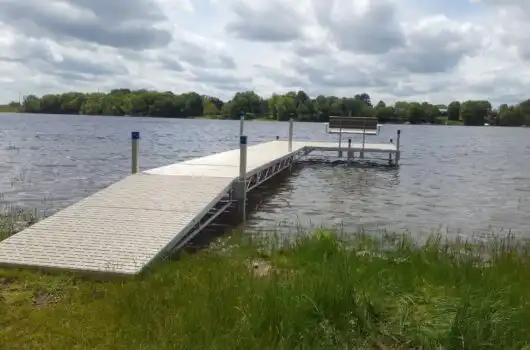
typical roll-in dock consists of two 16-foot sections with or
without an “L” on the lake end. The first 16-foot section comes
with a set of support legs about 12 feet from the shore end of
the dock. The next 16-foot length will generally be set up with
an axle and wheels situated about four feet from the lake end.
Optional wheels can be added at the starting shore section. This
allows one to roll the complete system in and out without ever
picking up the frame. The wheels used in a roll-in system
typically where old tires from salvage yards, or “space-saver”
spares. Nowadays, most companies have gone to roto-molded
plastic wheels. Several advantages come with this development.
Since the material is rigid plastic, tires won’t go flat. There
are no metal components to rust. These new tires address the
buoyancy issue, since they are hollow and will fill with water
when submerged. The old style car tires on lightweight aluminum
framed docks can add flotation to the system and therefore
decrease some of the stability. Another advantage is
aesthetics. It was difficult to come up with matching tires in
many cases. The tires would be of the same height, but of a
different tread pattern. This was not always acceptable to the
customer. Now, all tires are the same, and therefore on long
installations, there is consistency in the looks from end to
end. The final advantage is that they are completely recyclable
when they have outlived their useful lives. No bearings are
used in the wheels on a roll-in system, since the distance they
must travel is generally less than 100 feet.
Marine
Dock and Lift carries two brands of roll in docks, Private
Island and Shoremaster.
Each carries
it’s strong points
With
Private Island the dock frame is made of galvanized steel, or
aluminum. Aluminum being the most common frame material. The
frame is the “truss” style. The dock sides consists of two
parallel pieces of tubing reinforced with truss-style bracing
for reinforcement. This design can support heavy downward loads
on the dock consistently. Private Islands aluminum truss frame
carries a double full length stringer on all sections. This
came into being with the usage of vinyl’s for decking. The
vinyl’s do not have the structural load carrying capabilities
that the wood and aluminum deck panels have. Primary advantage
to the truss style frame is it’s light weight. The frame depth
is approx. 11” deep. A ridgid frame can be built while keeping
weight down. This makes for a roll in that is relatively easy
to install and remove from the water.
As
mentioned in the sectional area, Private Island offers many
decking choices. A grooved cedar decking in 4x4 panels. An
aluminum decking with vinyl insert. An all gray panel style
decking. Injection Grate gray vinyl. And finally, Durodeck
marine grade permanently attached plywood.
Shoremaster is our other supplier of roll in docks. They
feature a frame we call a “solid” side design, or “large tube
construction.” This design is also made of aluminum. The
solid side design is 6 ˝” in depth. To get the strength and
rigidity of the truss style, the wall thickness of the frame is
increased. Therefore, the dock is heavier than the truss
style. It typically carries a higher price tag because of the
extra material. The Shoremaster solid side system is a quality
built roll in. It is very clean in appearance. And it’s
appearance is one of the reasons many customers choose to
purchase it. The decking lies flush inside of the frame
system. No edges of the decking are exposed.
The
Shoremaster also includes large aluminum internally adjustable
legs. This allows height adjustment from on top of the dock.
All Shoremaster decking is removable in panel form.
Cedar,
IPE hardwood, white painted aluminum panels, and vinyl in 2002.
I should
note, treated wood is not an option offered for any docks we
sell with removable panels. Experience has shown us that the
treated material will warp and twist in the sun. If treated
material is used, it needs to be firmly attached. Even then, it
may still try to twist or warp as it is exposed to the hot
daylight sun. The other disadvantage to treated is the
weight. The treated panels tend to be considerably heavier than
cedar or the vinyl’s.
The main
reason people buy roll-in docks is the ease of installation and
removal. Be cautious though, when pulling or installing a
roll-in. More roll-in docks are damaged by improper removal or
installation than from storms or from boats tied up to them. To
remove the dock from the lake, one would take up the decking,
pull up the support posts, then pull the framework out of the
lake on its wheels by hand or with mechanical means, if
necessary. It can be as quick as a fifteen-minute process if
conditions are ideal, without steep hills and with ample space
on shore for storage. Installation is reversed, except that
additional time may be required to make the final adjustments to
the support legs if the water level has changed. Greater
lengths can be created by using hinge kits between each 32-foot
or 48-foot roll-in length. Installations in the 128-foot range
have been pulled out as a complete unit by a truck or small
tractor. Winch kits or adjustable screw legs are used to raise
or lower the full length of the dock to a desired height above
the water.
The
disadvantage of a roll-in dock system become apparent when the
dock is not sufficiently braced in deeper water (five to eight
feet). An unstable, side-to-side shimmy can result, which is
unsettling to some dock users. A cross chain kit added to form
an “X” bracing under the lake end eliminates this type of
motion. Another option that creates stability is to add poles
that auger into the lake bottom and attach to the dock with
brackets.
When
removing, if pressure ridges, bank cutouts, and or muck is
present, caution is required. One may need to lower the lake
end into the water to stabilize the upright poles for removal.
Another tool could be ramps to go over the berm. Ramps can be
as simple as 2 pieces of longer wood. The tires on the roll can
ride up onto the ramps. This keeps the uprights from being bent
or damaged should the wheels become stuck in mud or lodged
against a berm when being pulled out.
Roll-in
docks are easy to install, remove, and adjust to changes in lake
levels when used in an appropriate environment. They are a
popular style of dock in Minnesota and Wisconsin. |